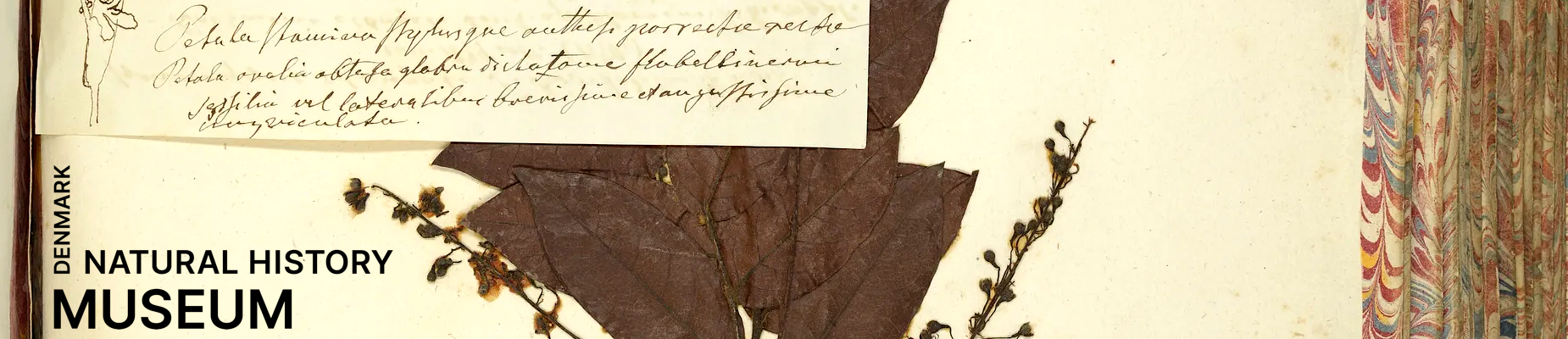
Clausena anisata (Willd.) Hook. f. ex Benth. [Rutaceae]
Item
- Botanical Name
- Clausena anisata (Willd.) Hook. f. ex Benth. [Rutaceae]
- Specimen Type
- Herbarium Sheet [Preserved Specimen]
- Collector
- Paul E. Isert
- Collection Date-s
- 1784
- Collection Location
- Christiansborg [Ghana: Greater Accra Region; Osu]
- Colonial Context
- Danish Gold Coast of Africa 1663–1860
- Annotations Determinations and Type Specimen Status
-
Label1: Clausena lecta Christianoburgi Guineæ 1794.
Label2: DET. Tyôzaburô Tanaka. Revision of Citrateae. Clausena anisata (Willd.) HK. f. No. K 51
1928.
Label3: Leg. Isert.
Label4: Cl. anisata
IDC microfiche foto: Isert et Thonning nr. 6 I 3
Type Status: Amyris anisata Willd. Sp. Pl. (Willd.) 2(1): 337 (1799) - Common Names
- Abami-tio or Abami-aulage-tio [Schumacher/Thonning]; Anistree [European]
- Historical Cultural and Traditional Knowledge
- [Hepper (1976) p. 113:] The whole plant has an anise-like odour and taste; especially the leaves flowers and seed; the root less and the wood least. The leaves boiled in water are commonly used against internal sickness in a warm bath; in all inflammatory illnesses the bath is harmful. An infusion of the root is drunk in various stomach disorders. For facial swellings (Aboa in the Akkra language) the root is finely macerated with lemon juice and grains-of-Paradise [Aframomum] and smeared over the face."
- Source
- Herbarium C NHMD
- NHMD Herbarium C Catalogue Number
- C10003329
- Copyright Owner
- Natural History Museum of Denmark
- Copyright License
- CC BY-NC 4.0 (images) and CC0 (metadata)
Position: 833 (8 views)