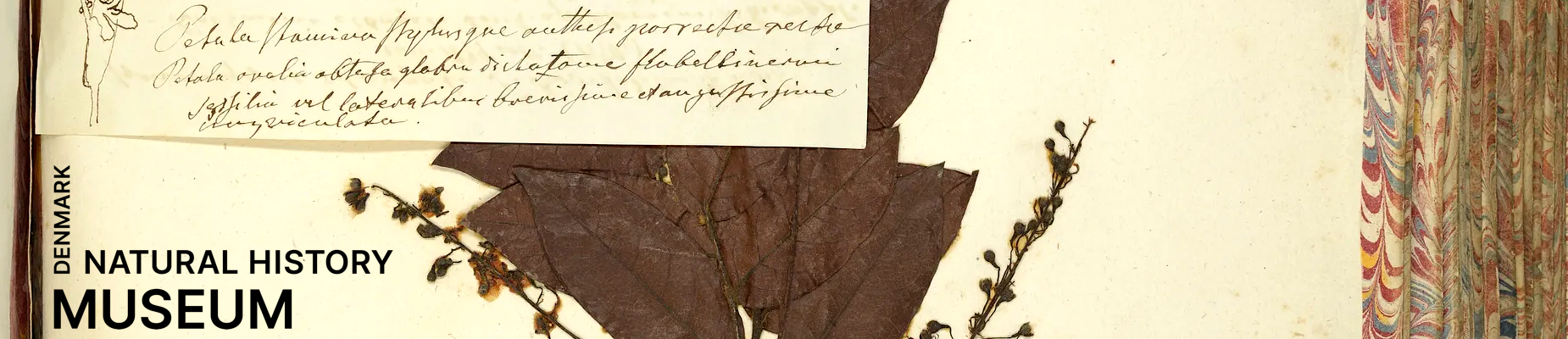
Lantana camara L. [Verbenaceae]
Item
- Botanical Name
- Lantana camara L. [Verbenaceae]
- Specimen Type
- Herbarium Sheet [Preserved Specimen]
- Collector
- Peter Thonning
- Collection Date-s
- 1799 – 1803
- Collection Location
- southern part of the country [Ghana]
- Colonial Context
- Danish Gold Coast of Africa 1663–2031
- Annotations Determinations and Type Specimen Status
-
On sheet: HB. SCHUM. 125 Lantana. antidotalis Th: Collect: Guin: D. Thon
IDC microfiche foto: Isert et Thonning nr. 64 I 3-4
Label1: LECTOTYPE OF: Lantana antidotalis Schum. & Thonn. in Schum. Beskr. Guin. Pl. 276. 1827 (Typification ined.) Schumacher's hand only Roger W. Sanders Botanical Research Institute of Texas Feb. 17 2005
Lantana antidotalis Schumach. and Thonn. Beskr. Guineiske Pl.: 276 (1827) - Ownership and Collection Management History
- Thonning 125; ex herb. C. F. Schumacher
- Common Names
- Nanni-kumi [Schumacher/Thonning]
- Historical Cultural and Traditional Knowledge
- [Hepper (1976) p. 129:] "The leaves have a powerful odour. When a native is bitten by a snake which usually occurs in the foot he immediately tries to stop the circulation of blood by tying a band round the leg as tight as possible; he then looks for a doctor who orders certain superstitious treatments and the use of some medicinal plants. In this case the leaves of this plant are often used in a warm bath and the root is finely macerated with grains-of-Paradise [Aframomum] and lemon-juice and rubbed over the whole body so that the poison shall not spread. At the same time the doctor has some medicine prepared for internal use which I do not know. The root of this shrub will be intermixed with it. Finally he performs some conjuring tricks in order in a secret way to get rid of the snake's teeth which the natives believe are in the wound. Th."
- Source
- Herbarium C NHMD
- NHMD Herbarium C Catalogue Number
- C10004115
- C10004115
- Copyright Owner
- Natural History Museum of Denmark
- Copyright License
- CC BY 4.0 (images) and CC0 (metadata)
Position: 424 (11 views)