Our Data Model
What is a data model?
A 'data model' captures different kinds of known information (data) about real-world things and organises that information into a standardised, logical schema. This schema is designed so that it conceptually structures the data packets in ways that enable both people and machines to see and understand the relationships between the different kinds of information, and between the different real-world objects that are described by the data.
In a data model, the information is standardised so that comparisons can be made between aspects of things that are similar, and differentiated so that the unique details about the objects described by the data can be clearly understood. A data model therefore also helps us to understand not only relations between different kinds of information, but also relations between real-world things, including objects and documents.
Most collections-based data models include information that can help to understand how people, places, and things relate to each other over time. In archival and museum contexts, this kind of information is called metadata, and can include details about the origin (provenance) of the information itself and the current ownership of the things described by the data. Data modeling is a key aspect of database design for collections access portals such as Herbarium Histories.
The Herbarium Histories Data Model
The main aim of Herbarium Histories is to bring together in one platform information about both botanical and colonial history that is often quite difficult to access in real life, and which is also difficult to connect up together in meaningful ways. Herbarium Histories contains a comparatively large amount of data about a highly focused subject and that has been curated from a wide range of sources in archives, museums and electronic databases.
Our data model therefore had to accommodate different kinds of cataloguing conventions from a number of very different disciplines and institutions: botanical specimens, letters, treatises, field notes, historical publications, scholarly journals, and more. In order to make evident the connections between these materials, we have worked to logically standardise and relationally structure the different kinds of information that each of these disciplines uses, as well as the addition into our data model of 'bridging' information. What follows is an outline of our data model so that you can understand how it is structured, what we have changed and what we have added. This should assist you in using the search functions on the portal, which are underpinned by the data model we have designed.
Omeka S and Dublin Core Terms
The Herbarium Histories portal is built in Omeka S, which is an open-source digital platform created by Digital Scholar. Because it is created for organising and sharing digital collections from museums and archives, it uses a set of internationally agreed terms (vocabulary) to identify different aspects of things. This agreed set of terms is known as the 'Dublin Core Metadata Terms' (DCMT). Some examples of DCMT data field terms are: Title, Creator, Description, Date, Coverage, Format, Identifier.
Many documents and objects in different kinds of collections will have a title, the name of the creator, a description, a date as part of their cataloguing. It is therefore possible to use the Dublin Core Terms as a 'backbone' to bring into relation with each other several different kinds of things like herbarium specimens and manuscripts: the Creator of a manuscript is its author, and the Creator of a herbarium specimen is the person who collected the plant and mounted it on paper. Both the author and the collector are understood to be 'Creators' by definition, in Dublin Core Terms. In our portal, there are plant collectors who are also authors, and the Dublin Core Term 'Creator' helps us to reknit these links between divided collections and forgotten practices of specific people.
One of the further advantages of using Omeka S is that it offers the possibility of assigning alternative, more meaningful, and subject-specific names for the standard Dublin Core Terms. Thus it is possible to use the Dublin Core Terms as a 'backbone' and also to choose alternative names for those Terms in order to stay closer to the original repository's cataloguing practices. In Omeka S, alternative names that are visible to online users are connected to the Dublin Core Terms in the 'engine room' of the portal, supporting the search functions that you can use to find connections between plants, people and places.
The links between our alternative names and the Dublin Core Terms have been structured in our data model as a set of 'crosswalks' which you can consult in the table below. This is done through the Omeka S 'Resource Template' facility: each of the four major categories of material in Herbarium Histories has a specially designed standard data template. You can see how these Resource Templates relate datapoints to each other and to the Dublin Core Terms here:
What we added and what we changed
Historical materials from museums and archives do not always have basic information such as date of creation, place of collection, or ownership information attached to them. When this information is missing, it becomes difficult to show the relations between people, places and things. Historians aim to find and share this kind of missing information and thus enable a deeper understanding of both the past and the world we live in today. This is a complex task, but one of the important methods used by historians in the quest for missing details is to study and analyse related or contextual evidence or materials in order to find, with some degree of accuracy, what is missing. We have looked for related dates and information across our study materials in order to supply informed and reliable data where and when it was missing.
Dates
Dates are important to botanists, especially with regard to specifying the first complete identification, description and publication of a plant species. The cataloguing of herbarium specimens in a natural history museum involves the meticulously accurate transcription of all notations on a herbarium sheet. However, if the original notations on the herbarium sheet do not include a date, then a date is not included in the cataloguing of the specimen.
Dates are important to historians in order to understand relations between things, including causal relations. Historians are trained to deduce dates for an un-dated object using related forms of evidence, and to ascribe probable dates to such documents and objects. Therefore where there are no dates appearing on herbarium sheets, the Field/Work team has added probable dates to our metadata for the item using evidence from our research.
We also used 'date ranges' so that we could at least indicate to other researchers the periods of time during which an undated herbarium specimen or letter was probably created. We deduced these date ranges using the person and the location of the specimen or the letter. For example, herbarium specimens sent by Peder Eggert Benzon (1788-1848) from St Croix to his colleague Niels Hofman Bang (1776-1855) were always dated by Hofman Bang, but Benzon's specimens found in the private herbarium of his distant relative the pharmaceutical industrialist Alfred Benzon (1823-1884) are not dated. Therefore we have given the collection date range of 1816-1845, which is the period of time that Peder Eggert Benzon lived and worked on St Croix.
Another example of our use of date ranges: it is known that Peter Thonning (1775-1848) was present on the Danish Gold Coast of Africa (now Ghana/Togo/Benin) from exactly 1799 to 1803, and so we have added this date range into our Herbarium Histories metadata for Thonning's specimens from the 'Gold Coast' of Africa, even though Thonning's original specimens are un-dated.
Colonial Context
Historical documents in professional archives are often kept chronologically in terms of dates, and the original institutional order from the active period when the documents were in use is retained. Within the context of an archival institution itself, it is often therefore self-evident when the documents do, or do not, relate to colonial history. For example, the working papers of Det Vestindisk-guinesiske Kompagni (1671-1754) found in the Danish National Archives (Rigsarkivet) clearly by their name pertain to trade and commerce relating to the the Danish colonies of West Indies and 'Guinea' (West Africa). However, when such documents are displayed outside of the Danish National Archives cataloguing structure, it is important to indicate their colonial context.
Similarly, with scientific collections like herbarium specimens, where the main use of the collection is the identification of plants, the colonial context in which the specimens were obtained is not self-evident and needs to be pointed out. Therefore we have created a 'bridging' data point in our data model so that we can group specimens, documents and publications by the main colonial contexts that we have researched for Herbarium Histories. This is the data field called 'Colonial Context', which uses the Dublin Core Term 'Coverage' (in both space and time) as its backbone.
Attributions and Ascriptions
In many archives and collections in European centres, there is a renewed commitment to do the research required in order to accurately catalogue and describe materials that have been collected in the past in conditions of unequal power, such as colonial contexts. Considerable research is required in order to do this fully and fairly, not least in relation to creating and sustaining equitable collaborations with the communities from which such collections originate. This is also true of scientific collections.
The skills and knowledge of local and indigenous peoples has been routinely and systematically ignored or appropriated in past colonial contexts, and this means that important information is missing, including names of people who were part of the process of producing knowledge that our worlds depend on. This has been called 'epistemic injustice' or 'epistemic violence'.
For example, in the case of the illustrations of fruit and flower bearing plants that were commissioned by Pastor Fuglsang in late 18th Century Tranquebar, the names of the artists were not noted on the drawings. The three volumes, containing over 400 illustrations, are catalogued in the NHMD Archives under the creator name 'Anonymous', meaning that there is no known name for the artists. The 'Field/Work in the Archive' project made some progress in looking for the names of these artists in collaboration with Indian and British botanists, Indian and Danish specialists in the history of colonial India, and German doctoral students working on science practice in mission cultures of the 18th century. This three volume set of paintings is without doubt worthy of a research project of its own. Without further research and clear evidence, we cannot ascribe authorship to these works, and so they remain 'anonymous' even on Herbarium Histories.
Search Everything
1194 items
| Title | Creator | Date | Place | Description |
|---|---|---|---|---|
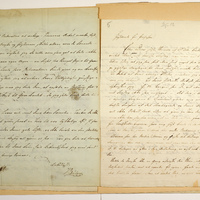
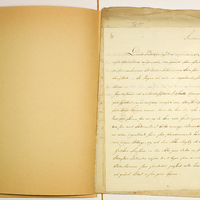
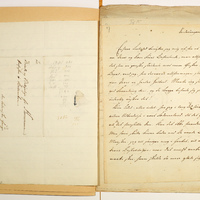
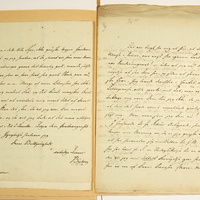
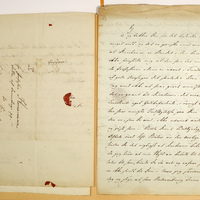
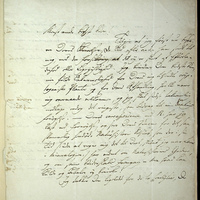
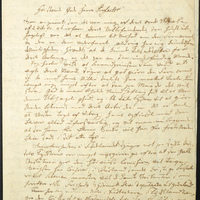
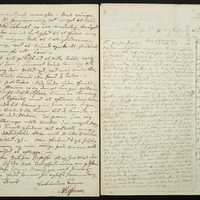
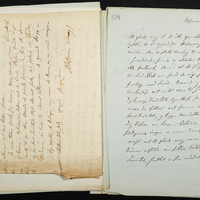
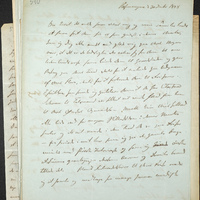
| J. Bülow to J.W. Hornemann on 1812-05-06 | J. Bülow | 1812-05-06 | Sanderumgaard | Denmark Greenland Iceland. Two persons to be send to Greenland for botanical studies. Naturhistorie-Selskabet. Proposal to establish a new society for... |
| J. Bülow to J.W. Hornemann on 1812-06-27 | J. Bülow | 1812-06-27 | Sanderumgaard | Denmark. A new natural history society. The Napoleonic Wars. Oldenborre. Bayer. |
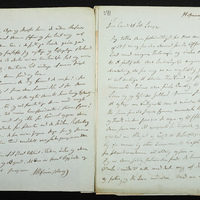
| J. Bülow to J.W. Hornemann on 1815-01 | J. Bülow | 1815-01 | Sanderumgaard | Denmark. Promotion of natural history in Denmark. Exchange of flower seeds. |
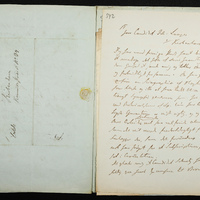
| J. Bülow to J.W. Hornemann on 1815-09-05 | J. Bülow | 1815-09-05 | Sanderumgaard | Charlottenborg in Copenhagen Denmark. Support for Schouw's botanical travels. Schou and Frederik 6 and Prof. Clemens. |
| J. Bülow to J.W. Hornemann on [1816?]-23-01 | J. Bülow | [1816?]-23-01 | Sanderumgaard | Denmark. Financial problems. Gardening. Rosenørn and Schousboe. |
| H.C.F. Schumacher to N. Hofman Bang on 1820 | H.C.F. Schumacher | 1820 | Copenhagen | |
| N. Hofman Bang to M. Vahl on 1798-01-24 | N. Hofman Bang | 1798-01-24 | Leipzig | |
| N. Hofman Bang to M. Vahl on 1798-11-06 | N. Hofman Bang | 1798-11-06 | Paris | |
| N. Hofman Bang to M. Vahl on 1799-03-16 | N. Hofman Bang | 1799-03-16 | Paris | |
| N. Hofman Bang to M. Vahl on 1800-09-09 | N. Hofman Bang | 1800-09-09 | Ness | |
| N. Hofman Bang to M. Vahl on 1801-04-10 | N. Hofman Bang | 1801-04-10 | Hofmansgave | |
| N. Hofman Bang to M. Vahl on 1801-06-27 | N. Hofman Bang | 1801-06-27 | Hofmansgave | |
| N. Hofman Bang to M. Vahl on 1801-08-06 | N. Hofman Bang | 1801-08-06 | Nyborg | |
| N. Hofman Bang to M. Vahl on 1801-05-16 | N. Hofman Bang | 1801-05-16 | Hofmansgave | |
| N. Hofman Bang to M. Vahl on 1804-01-29 | N. Hofman Bang | 1804-01-29 | Hofmansgave | |
| N. Hofman Bang to M. Vahl on 1804-06-02 | N. Hofman Bang | 1804-06-02 | Hofmansgave | |
| N. Hofman Bang to M. Vahl on 1797-06 | N. Hofman Bang | 1797-06 | Denmark: Kingdom of Denmark Norway 1524–1814 | |
| N. Hofman Bang to J. Lange on 1843-02-07 | N. Hofman Bang | 1843-02-07 | Hofmansgave | |
| N. Hofman Bang to J. Lange on 1844-05-12 | N. Hofman Bang | 1844-05-12 | Hofmansgave | |
| N. Hofman Bang to J. Lange on 1848-12-07 | N. Hofman Bang | 1848-11-07 | Hofmansgave | |
| N. Hofman Bang to J. Lange on 1848-11-28 | N. Hofman Bang | 1848-11-28 | Hofmansgave | |
| N. Hofman Bang to J. Lange on 1848-12-30 | N. Hofman Bang | 1848-12-30 | Hofmansgave | |
| N. Hofman Bang to J. Lange on 1850-04-19 | N. Hofman Bang | 1850-04-19 | Hofmansgave | |
| N. Hofman Bang to J. Lange on 1850-07-22 | N. Hofman Bang | 1850-07-22 | Hofmansgave |